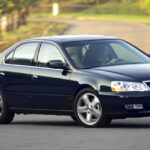
A power seat that moves in one direction but refuses to move in the other can make it tempting to immediately blame the seat motor or switch. On a 1999 Acura CL, however, testing the circuit before replacing parts can reveal a different failure.
We recently diagnosed a driver’s power seat that would move forward but would not move backward. Here’s how the problem was isolated.
The Symptoms
The driver’s seat had been moved completely forward and would no longer move backward.
When the forward switch was pressed, the slide motor could be heard clicking because the seat was already at the end of its travel. When the switch was pressed backward, however, there was no response from the motor at all.
That immediately suggested an electrical problem rather than a mechanically jammed seat track.
Step 1: Test Voltage at the Seat Motor
The slide motor on this Acura uses a simple two-wire circuit. The power seat system changes the direction of the motor by reversing polarity.
Testing across the two wires at the slide motor showed:
- Forward command: approximately 14 volts
- Backward command: no usable voltage
This explained why the motor wasn’t moving backward, but it didn’t tell us whether the motor itself was bad.
Step 2: Directly Power the Seat Motor
The motor was disconnected from the vehicle’s wiring and supplied with power and ground directly.
With polarity applied one way, the motor operated in one direction. Reversing power and ground caused the motor to operate in the opposite direction.
The seat moved backward normally when the motor was powered manually.
This confirmed that both the slide motor and seat track were functional.
Replacing the seat motor at this point would not have fixed the vehicle.
Step 3: Test the Driver’s Power Seat Switch
The wiring diagram showed that the driver’s power seat switch sends the directional command toward the power seat control module.
Testing the slide-switch circuit showed approximately:
11.98 volts in both directions, with the polarity reversing when the switch direction was changed.
That was an important result.
The driver’s power seat switch was doing its job. It was providing the proper directional command, so replacing the switch would also have been unnecessary.
Step 4: Test the Power Seat Control Module
At this point, we knew:
Power seat switch → correct directional signal → Power seat control module → incorrect output → Slide motor
Power was present going into the power seat control module, and the polarity changed appropriately depending on whether forward or backward was selected.
Testing the output from the control module revealed the failure.
The module would provide the correct output to move the seat forward, but when backward was commanded, the module failed to reverse polarity at its output.
That isolated the problem to the power seat control module.
Final Diagnosis
The testing confirmed a failed driver’s power seat control module.
The diagnosis was supported by three separate findings:
- The slide motor operated normally in both directions when directly powered.
- The driver’s power seat switch produced the proper forward and backward commands.
- The power seat control module received those commands but failed to reverse polarity to the motor for backward operation.
Rather than replacing a motor or switch based solely on the symptom, electrical testing allowed the actual failed component to be identified.
Why Electrical Diagnosis Matters
Power accessories can be deceptively simple. A motor that works in one direction but not another doesn’t necessarily have a bad motor, and a switch that appears unresponsive doesn’t necessarily mean the switch itself has failed.
Testing power, ground, voltage and circuit operation at each point can prevent unnecessary parts replacement.
At Torque Mobile, we use electrical testing and wiring diagrams to diagnose problems before recommending repairs. Whether it’s a power-seat issue, starting problem, charging-system fault, check-engine light or another electrical concern, the goal is to determine why the component isn’t working before replacing it.
Need Mobile Automotive Diagnostics in the Tri-Cities?
Torque Mobile provides on-site automotive diagnostics and repair throughout the Tri-Cities, Washington area, including Richland, Kennewick and Pasco.
Instead of bringing the vehicle to a repair shop, we bring the diagnostic equipment and service to you.